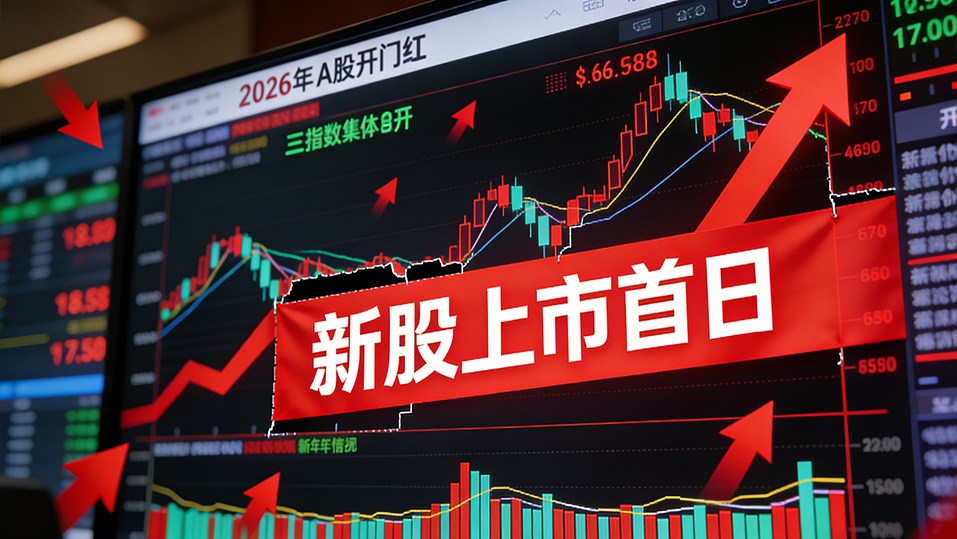






2025 has come to an end, and we are now officially welcoming 2026. In 2025, the A-share and Hong Kong stock markets performed exceptionally well, with the Shanghai Composite Index once breaking through the 4,000-point mark, achieving a full-year gain of 18.41%. The Shenzhen Component Index and the ChiNext Index recorded full-year gains of 29.87% and 49.57%, respectively.
This bull market began in late September 2024 and experienced two significant rallies: one from late September to early October 2024, and the other from early April to early November 2025.
Among them, the rally from late September to early October 2024 was characterized by a rapid rebound from the bottom, leaning more toward a comprehensive bull market. However, it took only 15 trading days to complete a surge of over a thousand points, and on October 8, the A-share market even set a single-day trading volume record of 3.45 trillion yuan.
In early April 2025, impacted by U.S. tariffs, the Shanghai Composite Index briefly fell to 3,040 points, which became the new starting point for the second rally. From early April to early November 2025, the index climbed from 3,040 points to 4,034 points, completing a thousand-point gain in just seven months.
Compared to the first rally, the second one leaned more toward a structural bull market rather than a comprehensive bull market. The characteristics of this structural bull market were reflected in localized profit opportunities, with core stocks in sectors like technology and rare metals experiencing significant gains, driving the sustained upward trend of the market. In contrast, sectors such as consumer goods and securities underperformed the broader market indices and even experienced declines throughout the year, making 2025 a year of severe market divergence.
As we enter 2026, will the Chinese stock market transition from a structural bull market to a comprehensive bull market? Ultimately, it depends on three key factors.
**The first factor** is whether the market has sufficient capital to support a shift toward a comprehensive bull market.
In 2025, the A-share market witnessed multiple instances of single-day trading volumes exceeding 3 trillion yuan. Near the 4,000-point level, substantial profit-taking pressures accumulated. To effectively absorb the floating supply of stocks, the market needs to generate even larger trading volumes. In 2026, for the A-share market to firmly stabilize above 4,000 points, the average daily trading volume must reach a higher level. Factors driving sustained growth in trading volume include the conversion of household savings into investments, continued expansion of margin trading balances, ongoing capital increases by industrial players, and sustained inflows of medium- to long-term funds.
**The second factor** is whether the external environment continues to improve, creating favorable conditions for the A-share market to transition into a comprehensive bull market.
The improvement of the external environment is also a critical factor for the A-share market’s shift toward a comprehensive bull market. Specifically, whether the Federal Reserve will continue its rate-cutting cycle in 2026 and whether the frequency and magnitude of rate cuts will exceed market expectations will significantly impact the trajectory of the U.S. dollar. The movement of the dollar, in turn, influences the direction of most global asset prices. A persistently weak U.S. dollar index and sustained rate cuts by the Federal Reserve would create favorable external conditions for the A-share and Hong Kong stock markets.
**The third factor** is whether economic data and the fundamentals of listed companies continue to recover, serving as an internal driving force for the A-share market’s transition into a comprehensive bull market.
For the A-share market to break through to higher levels, it requires strong fundamental support. For instance, sustained recovery in economic and consumption data, along with significant improvements in the earnings growth of listed companies, will directly enhance the investment value of the A-share market. If the earnings growth of listed companies continues to improve and economic fundamentals and consumption data steadily recover, the valuation center of the stock market will reach a new level.
According to public data from the Shanghai Stock Exchange on the last trading day of 2025, the average price-to-earnings ratio (P/E ratio) of the Shanghai Composite Index was approximately 16.3 times. The average P/E ratio of the Shanghai Main Board was about 14.79 times. Data from the Shenzhen Stock Exchange showed that as of December 31, 2025, the average P/E ratio of the entire Shenzhen market was around 31.59 times, while that of the Shenzhen Main Board was approximately 25.20 times.
**Is the current valuation of the A-share market overpriced?**
The current valuation level of the A-share market incorporates market expectations for the earnings growth of listed companies in 2026. If the earnings growth of listed companies exceeds 10%, the forward P/E ratio of the A-share market would significantly decrease, alleviating valuation pressures.
Compared to the U.S. stock market, the current valuation of the A-share market is much lower. The average P/E ratios of the three major U.S. stock indices are all above 30 times, with the Nasdaq’s average P/E ratio exceeding 40 times. In contrast, the average P/E ratios of the Shanghai and Shenzhen main boards are relatively lower. If compared using the average P/E ratio of the CSI 300 Index, the valuation advantage of the A-share market becomes even more pronounced.
The level of stock market valuations is also closely linked to liquidity conditions.
For example, during a bull market, ample liquidity allows stocks to command higher valuation premiums, which is one of the main reasons why growth stocks generally have higher valuations than traditional value stocks. In a bear market, significantly tightened market liquidity reduces the investment appeal of stocks, making it difficult for the market to sustain high valuation premiums.
Currently, the A-share market is in a bull market, allowing it to enjoy higher valuation premiums. If benchmarked against the valuation levels of mature markets in Europe and the United States, the current valuation of the A-share market is not expensive. If the earnings growth of A-share listed companies in 2026 exceeds market expectations and market liquidity continues to improve, the A-share market has the potential to transition from a structural bull market to a comprehensive bull market in 2026.